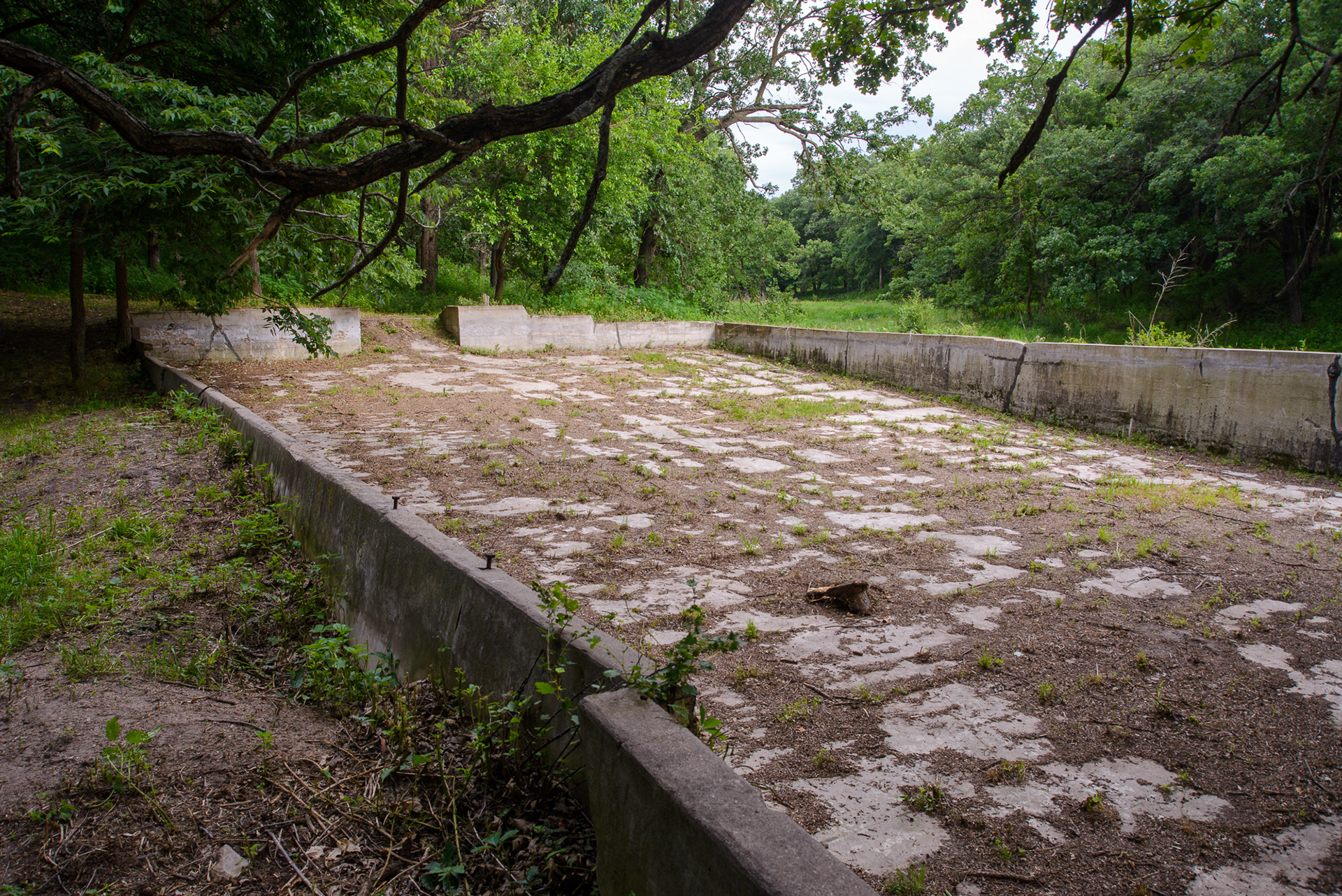
The pool in July 2014.
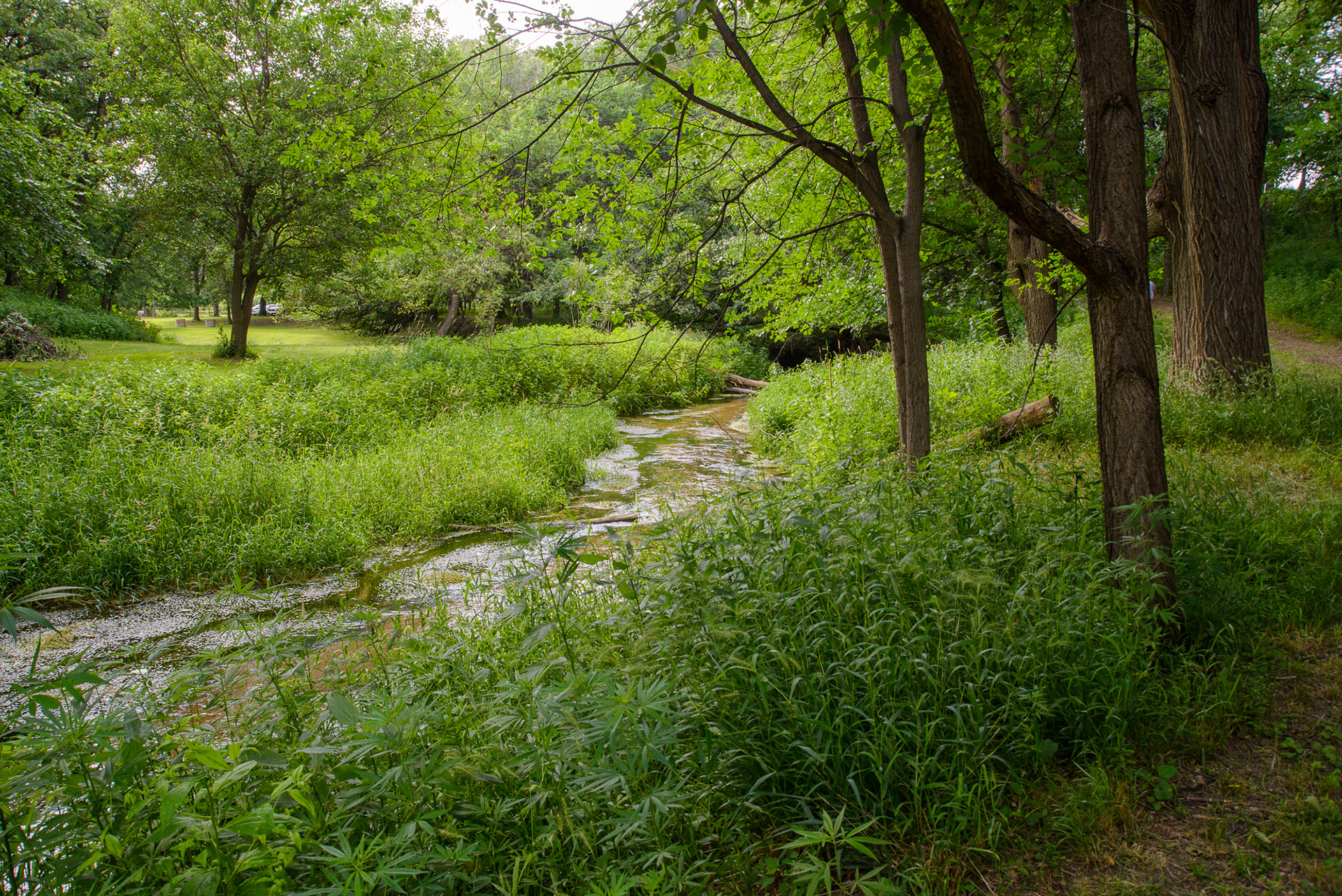
Verdigris Creek running through the former Dikeman's Park land.
Reunion Sparks Memories of Dikeman's Park
LuAnn Schindler, Managing Editor lschindler@nelighnews.com Aug 1, 2014
LuAnn Schindler, Managing Editor lschindler@nelighnews.com Aug 1, 2014
Nestled amongst the tall oak trees and cool water of the Verdigris Creek, in a small valley northeast of Royal, sits a reminder of simpler times.
At this spot, in a pasture-turned-park, are the cracked remains of a swimming pool, a portal to the past that evaporated as quickly as the crowds that used to gather here, around the pool, at Dikeman’s Park.
Between July 2 and 5, the pristine quiet gave way once more to laughter, as descendents of the Dikeman family reunited at the spot built in 1920 by Clarence Dikeman.
“It was wonderful,” said Ginny Hoernicke, a 1966 Neligh graduate now residing in Hays, Kansas. “It’s the first time I remember all of us there.”
For just over two decades - 1920 through 1941 - the Dikeman farm, and eventually the park, offered area residents an escape from the sun-drenched heat permeating the Nebraska plains, a chance to relax under the shade of sprawling trees and enjoy a dip in the creek.
The road to the farm was ungraded, nothing more than a winding trail. But that didn’t keep carloads of people and picnickers from showing up.
Once Dikeman realized the number of people that made the trip to the country, he moved the picnic grounds to a pasture across the road.
“On Saturday afternoons, cattle were moved to other grazing grounds and then the pasture was cleaned up for Sunday visitors,” Hoernicke said.
Originally, the park was only open on Sundays. And the crowds, well, they kept coming in droves.
Dikeman tapped a spring for drinking water and started charging a 25-cent admission fee.
According to an article written by Dikeman’s daughter, Vivian Taylor, in the Antelope County History book, $4 was raised the first Sunday. The proceeds were used to construct an outhouse, with the remaining balance earmarked for picnic tables.
Toward the end of the summer of 1920, park visitors expressed interest in a swimming pool.
Dikeman, along with Royal businessmen Harry Darling, from the lumber yard, Cedric Lucas, Royal State Bank, Otto Puttney, Citizen’s State Bank and Cliff Rundquist developed plans for the 30x40 foot pool and saw the hand-poured structure come to fruition.
By 1923, a second pool, measuring 50x90 feet was constructed.
The new pool held 150,000 gallons of water. Each Monday, the pool was drained and cleaned. Then fresh water from the nearby creek was pumped in by a water wheel, which allowed for a continuous exchange of water.
A diving board and slide were added to the pool, which measured eight feet at its deepest spot.
Dikeman’s pool was the first and only cement swimming pool between Sioux City and Chadron State College.
Other amenities were built on the site.
In 1924, an open-air dance floor was added. It lasted only a handful of years, until weather ruined the floor.
A clay tennis court was built in 1936, and during 1938, a sand greens golf course was laid out on the hill just north of the park.
By 1941, the size of the crowds had dwindled - possibly because of the war effort - so the Dikeman family closed the park.
Hoernicke said the park was popular because it was a place where families could go and spend time together and take part in a variety of different recreation opportunities.
“There was economic impact, too. Think of the number of people who drove miles and miles,” Hoernicke said.
On the final day of the Dikeman reunion, the park was opened to community members.
Hoernicke said approximately 25 people visited, sharing stories and walking through the area. Others, she said, were curious about the park they have heard so much about.
“I heard over and over, ‘Oh, my grandparents learned to swim at Dikeman’s Park,’” Hoernicke added. “This place had an impact on the community.”